FROM BLACK CENTIPEDE CONFIDENTIAL
GET IT ON AMAZON KINDLE:
http://www.amazon.com/Black-Centipede-Confidential-Chuck-Miller-ebook/dp/B00SP5W6QI/ref=dp_kinw_strp_1
OR IN PAPERBACK:
http://www.amazon.com/Black-Centipede-Confidential-Chuck-Miller/dp/1507689209/ref=la_B005WX2CKQ_1_1_title_1_pap?s=books&ie=UTF8&qid=1434961447&sr=1-1
CHAPTER FOUR: SCOTT AND ZELDA
One hour later, I was at the rendezvous point Proofy had relayed to Amelia's contact.
There he was, standing on the sidewalk in front of the drugstore where he had been instructed to meet me. He was bundled up in an overcoat-- an expensive bit of merchandise that was beginning to run to seed. He was hatless, but had a scarf wound around the lower part of his face, and he was bouncing up and down on the balls of his feet.
I pulled the Duesenberg up to the curb, rolled down the window, and in a low, mysterious voice, delivered the first part of the code I had relayed to him via Prufrock:
“Then wear the gold hat, if that will move her; If you can bounce high, bounce for her too...”
He glanced up and down the street, stepped up to the curb, and said, “Till she cry ‘Lover, gold-hatted high-bouncing lover, I must have you!’”
I nodded and reached over to open the passenger door. “Get in.” He climbed into the seat beside me, fumbling and stumbling a bit as he did so. I gave no indication that I had noticed it.
Safely inside, with the door closed, he pulled down the scarf and whispered, “You’re the Black Centipede?”
I nodded again. “F. Scott Fitzgerald, I presume?”
Corny, I know, but I couldn’t resist. The city really is like a jungle sometimes, and Fitzgerald did look a bit like a long-lost explorer. In fact, he looked shell-shocked.
Ten minutes after I picked him up, we were in my office in the Benway Building. I had gone through an appropriately melodramatic bit of rigmarole, instructing him to don a black blindfold for the trip to my "super-secret headquarters." He had eagerly complied, seemingly delighted with my pointless skullduggery. I had taken a roundabout route back to the Benway, then pulled into one of my concealed entrances in the back alley. The secret freight elevator had hauled the Duesenberg, and us with it, up to the 66th floor. J. Alfred Prufrock had taken F. Scott Fitzgerald's coat and scarf, ushered us into my private sanctum, and made himself scarce.
"Have a seat, Mister Fitzgerald," I said as I moved around behind my desk. I got comfortable in my chair, and my visitor got uncomfortable in his.
"So you've heard of me?" he said with a sickly smile on his face.
"Well, of course I've heard of you," I said. "Who hasn't?
The Great Gatsby is one of the five best novels I've ever read."
"What are the other four?" he asked, narrowing his eyes. "Are any of them mine?"
I laughed. "Learn how to accept a compliment, Mr. Fitzgerald. You've produced a genuine masterpiece. That's more than most people ever do."
He shrugged. "I suppose so. But the public has a short memory. Gatsby was eight years ago. You're only as good as your last big hit, and it has to have been last week, or nobody gives a shit about you."
"You've spent too much time in Hollywood," I said.
"Probably. In fact, in a roundabout way, that's why I've come to you. I knew Roscoe Arbuckle from some of my earlier trips to Hollywood. I talked to him the day before he died, in fact. He told me about what you did for him."
I sighed. "I'm afraid all I did was help him into an early grave."
Scott Fitzgerald shook his head. "It wasn't early. If anything, it was twelve years late. He'd have gotten there with or without you. He was just that kind of person. He never got over what happened with... you know. He'd been dead since 1921. There are some things you just can't come back from."
I sensed that this was a man who knew exactly what he was talking about. I wondered if Fitzgerald had something he could never come back from. I had a feeling that if he didn't already, he'd find one sooner or later.
"Well, anyhow," he continued, "after the thing I'm here to tell you about happened, I remembered what Roscoe had said about you. I looked up Big Jack Matteo-- he has a pretty high opinion of you, by the way-- and he suggested I get in touch with Amelia Earhart."
The poor man looked rough, as though the talking he'd just done had been an ordeal. The tremors I had noticed in his hands told me everything I needed to know.
I very casually opened a desk drawer and got out two thick glass tumblers and a bottle of scotch. As I placed them on the blotter, Fitzgerald underwent a transformation. His agitation had changed from pure distress to quivering anticipation. Without saying a word, I opened the bottle, filled the glasses, and pushed one of them in his direction. He accepted it as nonchalantly as I had offered it, and slowly raised the glass to his lips. The beatific look that spread over his face after he gulped down half of its contents told the story.
"Go ahead and finish it," I said gently. "There's plenty more, and you can have all you want. There is no judgment here."
With that, I pushed my mask up over my nose, drained my own glass, put it down, and filled it again. Smiling tentatively, Fitzgerald polished off the rest of the scotch in his tumbler. When he put it back on the desk, I filled it again.
He sipped his second drink almost languidly, free of his earlier quiet desperation. "Call me Scott," he said, leaning back and crossing his legs.
"Very well, Scott," I said. "Now, Tell me why you wanted to talk to me."
"It's my wife. Zelda. She's... missing."
"I see. Surely this is a matter for the police."
He shook his head. "No. There are... circumstances. It's hard to explain. She's gotten... involved with someone."
"I sympathize, Scott," I said, "but I'm not a private detective. If it's a divorce action, I'm afraid I..."
I knew better than that, of course, but I wanted to prod him, draw him out. I could tell he was having trouble with this, and little indignation can be a wonderful tongue-loosener.
"No, no, no," he said, in a voice that was morose and urgent in equal measure-- almost a wail. "I'm not an idiot. Not in that way, anyhow. You don't think I'd come to you with... This isn't anything as normal as an affair. That's why I can't go to the police or anybody else. That's why I thought of you... Listen, I don't know any way to say this that doesn't sound crazy, so I'll just say it:
"Zelda has taken up with a vampire."
There it was. He sat back in his chair, looking exhausted but hopeful, waiting for my response.
"Dear me," I said. "Let me refill your glass."
His face fell. "You think I'm nuts."
I shrugged. "You may well be, for all I know. It's relative, of course. But I'm not dismissing what you're saying."
"No? That's refreshing. I have a reputation as a drinker, you know."
I nodded. "My understanding is that you come by it honestly."
He laughed. "You don't mince words, Centipede... and I appreciate that, actually. So many people just try to dance around it. Yes, I drink. Therefore, any sensational story I tell people is taken with an entire salt mine, and assumed to be drunken raving. Fitzgerald is a drunkard, so Fitzgerald is seeing things."
"Being drunk," I said, "does not typically cause hallucinations. Delirium tremens do, but those are caused by the absence of alcohol in a system accustomed to it."
"Which mine is," he said with the strange, rueful pride of the alcoholic who has resigned himself to his fate, and finds a certain perverse satisfaction in it.
"The story, Scott," I gently prompted. He nodded and took a deep breath.
***
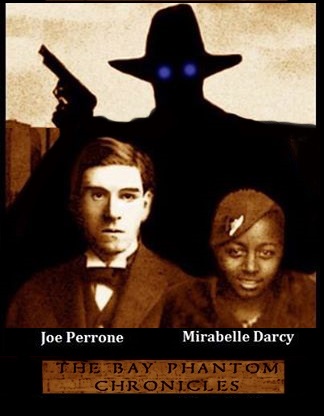
FROM THE BAY PHANTOM: A CONFEDERACY OF DEVILS
GET IT ON AMAZON KINDLE:
http://www.amazon.com/Bay-Phantom-Confederacy-Devils-Chuck-Miller-ebook/dp/B00O8WNNJ6/ref=la_B005WX2CKQ_1_11_title_0_main?s=books&ie=UTF8&qid=1434961447&sr=1-11
OR IN PAPERBACK
http://www.amazon.com/Bay-Phantom-Confederacy-Devils-1/dp/0692308342/ref=la_B005WX2CKQ_1_11_title_1_pap?s=books&ie=UTF8&qid=1434961447&sr=1-11
CHAPTER TWENTY-SIX: A PLAGUE ON ALL YOUR HOUSES
The Bay Phantom had arrived downtown a few minutes earlier, having taken a tunnel that came out in the living room of a vacant house on Royal Street. Smoke hung in the air from all the explosions, and sirens wailed in every direction. He questioned a couple of passers-by, who told him of the ominous gathering at Cathedral Plaza. The Phantom proceeded to the little speakeasy that seemed to have become Louis Rickert's second home. Sure enough, there was Rickert, sitting at the bar, sipping a highball.
"Louis, it's mid-afternoon," the Phantom scolded, "and I need your help. Are you too intoxicated to accompany me?"
"Hell, you act like I'm a damn alcoholic," Rickert said indignantly, barely slurring his words at all. "I'm always fit and ready to serve, Boss."
They headed west on Dauphin Street, bound for Cathedral Plaza. The Bay Phantom was appalled at what he saw.
This was a war between two factions, one represented by the KKK, the other by the Black Embalmers. There were skirmishes going on all over downtown. The Phantom imagined that most of the Klansmen weren't genuine members, but hired hands. The same went for the Black Embalmers. Here were the missing bully boys he'd been seeking.
Ordinary citizens, too, had entered into the chaos, becoming involved in the wild melees. Some of them fought Klansmen, some fought Black Embalmers, and some fought one another. Old grudges had resurfaced to take advantage of the atmosphere of sudden, lawless violence. There were looters at work, too. The Phantom shook his head at this, more in sorrow than in anger.
"Attention, looters!" he said loudly as he made his way along Dauphin Street. "Many of you are no doubt caught up in the heat of the moment and are allowing yourselves to be carried away by your emotions! But a critical situation exists in this city, and your actions are not going to help restore order!"
There was a commotion in front of the little peanut shop that had been a fixture of the downtown area for many years. The proprietor of the shop had pursued a young man into the middle of the street, and was menacing him with a shotgun.
"What is this?" the Phantom asked.
"This little bastard snatched a handful of money out of my cash register, that's what!"
The Phantom looked at the youngster and said, "Is that true?"
The boy shook his head. "He's lying, mister. He must be crazy or something."
"I'm gonna blow his goddamn head off!" said the shop owner. "That'll teach all these punks a lesson!"
"I'm sorry," said the Phantom, "but I cannot allow bloodshed over crimes against mere property. And that language hardly does credit to a merchant whose clientele includes women and children."
"Then stop me," the man said defiantly, raising the gun and drawing a bead on the young thief. his finger tightening on the trigger.
"Very well," said the Phantom. "You're just too excitable right now. I'm sorry I have to do this."
He threw a short right jab at a spot just underneath and behind the merchant's ear, instantly rendering the man unconscious.
"Now," he said, turning to the young man, "I would appreciate it if you would give me the money you stole. You may go about your business, but I hope you've learned a lesson. I don't want to find you causing any more problems."
"No! I mean, yes, yes I won't cause no more nothing!" he dug down in his pants pocket and extracted two wads of bills. "Here, take it, Your Honor! Please don't hit me."
"I'm not going to hit you," said the Phantom, "but I want you to go right home and stay out of trouble."
The young man nodded wildly and swore to God he'd never even think of stealing again. He spun on his heel and dashed away.
The Phantom stopped down and took a ring of keys from the unconscious proprietor's belt.
"Louis, please go put this money back into the cash register, and lock the door when you come back out. And drag this poor fellow inside, where he'll be relatively safe."
As Rickert moved to obey, the Phantom addressed the crowd at large:
"I understand the seductive nature of temptation, especially at a time like this, and I'm not condemning any of you! Nor do I have time to stop you. But I urge you to do the right thing! If you are unable to stop yourself now, please give it some thought in the days to come! If you need to, please consult a clergyman or some other respected authority!"
Rickert had dragged the shop owner back into his shop and tucked him away behind the counter. While the Phantom was too busy orating to pay any attention to him, Rickert pocketed the money he had been entrusted with, then helped himself to what was left in the cash register. For good measure, he stuffed two bags of roasted peanuts into his jacket pockets.
And then the gunfire started.
"Dear Lord," said the Phantom, "that's coming from Cathedral Plaza."
*
When the boy who had fired the first shot saw what he had done, he screamed, threw his shotgun down on the sidewalk, and took off running. Most of the other Klansmen in the Plaza produced firearms of various kinds and opened up on the line of Black Embalmers in front of the Cathedral. The Embalmers returned fire. A few of them held the line, while the others retreated into the building.
The Embalmers were all equipped with bullet-proof undergarments, while the Klansmen were not. Several of the latter went down in the first barrage, white robes marred by large splotches of red. A couple of them realized what was going on and concentrated on the heads of the Embalmers. Two of them were killed, and the rest retreated into the Cathedral.
Meanwhile, running gun battles and brutal fistfights between Klansmen and Black Embalmers raged for blocks in every direction around the Plaza. The Embalmers had the upper hand in most cases, and a number of them broke off from their satellite conflicts and headed for the Cathedral.
A line of Embalmers quickly assembled on a side street and crept up behind the Klansmen who were still firing on the Cathedral, their bullets knocking chips out of the front steps and punching holes in the doors. They raised their weapons and were about to cut the sheeted men down when one of the Daughters of the Confederacy spotted them. She yelled at her sisters, and they all turned to face the would-be ambushers.
Three of them reached under their hoop skirts and produced sawed-off shotguns. One of the girls, an attractive redhead, took aim at the nearest Black Embalmer and fired, hitting the macabre mask dead-center. The Embalmer went down, his head exploding in a cloud of red-tinted plaster dust.
*
"What the hell!" Rickert exclaimed.
He and the Bay Phantom had reached Cathedral Plaza, and they were both having trouble believing their eyes.
"It's a proxy war," said the Phantom. "The real generals are hidden away safely somewhere, while their minions decimate one another's ranks."
The gunfire had petered out for the time being. Several Klansmen, Black Embalmers, and hapless citizens lay dead or dying.
"Very well!" yelled the real Embalmer from atop the Cathedral. "If these miserable would-be dictators want war, then war they shall have!"
With that, the Embalmer disappeared from view. Ten seconds later, one last transport arrived at the plaza, stopping in the middle of Dauphin Street. Two Klansmen jumped out of the cab and ran to the rear of the vehicle. They jerked the doors open and stood back.
A bulky, furry apparition jumped from the truck.
The Werewolf had arrived.
The monster bounded into the middle of a group of Black Embalmers and started shredding everything within reach. Ribbons of shredded lab coats and gouts of blood went sailing into the air. People started screaming.
And then the situation got worse.
Something stirred in the windows of both of the Cathedral's towers. Then came the sound and fury, in the form of a horrible, explosive chattering sound and a hail of hot lead. There were two machine-gunners up there, one in each of the twin towers. They had the high ground, and were taking ruthless advantage of it.
"Two more of those missing machine guns, I'd wager." the Phantom said. He was trying to formulate a quick plan when he saw something that instantly became his top priority.
Two children, a boy and a girl, had somehow managed to wander into the middle of the Plaza. They were standing stock-still and obviously terrified. The trail of bullet impacts from one of the machine guns was moving along the ground, kicking up grass and dirt, heading straight for them.
The Bay Phantom sprang into action. He ran toward the children, dodging Klansmen, Black Embalmers and bullets. He snatched up the children and ran to the end of the Plaza furthest from the Cathedral. There was a good-sized gazebo there, a few feet from the sidewalk. The Phantom raced around behind it and lowered the children to the ground. He instructed them to crawl under the gazebo, which was raised a couple of feet off the ground, and stay there until he came back for them.
The Werewolf went down under a hail of machine-gun fire. The Phantom didn't think any of the bullets had penetrated his armor, but the impacts would have caused a great deal of distress. The gunners were concentrating their fire on the huddled figure. Bullets were ricocheting every which way. Six Klansmen and four Black Embalmers went down with obviously fatal head wounds.
Patches of the Werewolf's fur had caught on fire from the sparks struck from his armor by the bullets. He heaved himself upright, howled, then dropped again and rolled across the grass, evading the gunfire and extinguishing the flames at the same time. He rolled behind the gazebo, out of the line of fire.
One of the Daughters of the Confederacy dashed around the other side of the structure and placed the barrel of her shotgun against the nape of the monster's neck. Evidently, she didn't know whose side he was on. Either that, or she decided it would be a good idea to eliminate him regardless of affiliation. But before she could fire, the Werewolf lashed out. The first swipe of his claws shredded her pink hoop-skirt. The second laid her abdomen open from breastbone to groin. But she had hung on to the gun, and she used up what little life was left to her by trying to take a shot at her killer. It was a valiant effort, but her shot went wide. The Werewolf, on his feet again, kicked her in the face. She went staggering backward, leaving a trail of spilled entrails in her wake, before collapsing into a lifeless heap of blood, guts and ruined crinoline. The Phantom hoped those children hadn't witnessed that.
The Werewolf scampered off around the perimeter of the battle zone, slowing down now and then to disembowel one of the counterfeit Black Embalmers.
The Phantom wanted to pursue the monster, but the gunners in the towers were a much bigger problem. They were killing indiscriminately-- their enemies, their comrades, and the handful of innocent bystanders who hadn't made it to safety were all fair game, it seemed. He needed a few seconds to think, so he ran over to the gazebo and ducked around behind it. Crouching down he peered beneath the structure and saw that the children seemed to be unharmed.
Rickert was already back there, crouched down, popping up now and then to take a potshot at an Embalmer or a Klansman.
The machine guns in the towers fell silent, but he knew they were likely just switching out belts. Handing him a loaded automatic, the Phantom told Rickert to try to circle around and get as close as he could to the tower on the left. Rickert nodded and took off.
The Phantom was steeling himself for a suicide run at the right-hand tower when he heard someone call his name. Whirling, he saw Mirabelle standing at the mouth of a narrow alley just across the street, not twenty feet away. She had on the black stealth suit she'd worn in New Orleans. A long, tubular apparatus was slung over her shoulder by a strap, and she carried a paper bag in one hand.
"Mirabelle!" the Phantom exclaimed. "What on..."
"Shush!" she interrupted. "Don't use my name! You don't want people to know I know the Bay Phantom. Hang on one second. I have an idea."
She put the bag on the ground and removed from it two odd-looking objects, which she shoved into her belt. She took a jackknife from a front pocket and cut two small holes in the paper bag, then pulled it over her head, adjusting it so she could see through the holes. That done, she dashed across the street, joining the Phantom behind the ruined gazebo.
"How did you get here?" the Phantom asked.
"One of your tunnels comes out under the Saenger Theater, remember?" She took the large, tubular apparatus off of her shoulder and handed it to him. "This is that thing I was working on, the rocket launcher. I'll load it for you. I only brought two of the projectiles, so make 'em count."
"How did you know I'd need this?" he asked.
"How the hell would you not? Let's do it."
The Phantom stood up and balanced the weapon on his shoulder. "I hate to do this to such a storied old building," he said, "and a cathedral at that. Those towers have been there since the 1890s. But this has got to stop."
He took aim at the right-hand tower and depressed the trigger. The projectile disappeared into the gloom behind the machine gun, then there was a flash and a terrific explosion. A plume of smoke rose into the air, and debris rained down onto the street and sidewalk.
Mirabelle reloaded the launcher as the remaining machine gun opened up again.
"Forgive me," the Phantom said sorrowfully as he fired on the right-hand tower. It reacted exactly as its twin had.
The children crawled out from under the gazebo.
"Hey!" said the boy. "Ain't you the Bay Phantom?"
"
Aren't I the Bay Phantom," the masked man corrected him.
"You mean you don't know?"
"Who are you?" the girl asked Mirabelle, who was slinging the rocket launcher back over her shoulder.
She seemed startled by the question. "Me? I'm, uh... I'm Paper Bag Girl. This thing on my head is a paper bag, see?"
"I know what it is,” the girl replied smartly. She appeared to be about six or seven years old, but there was something in her eyes that belonged to a much older person. “It says 'Piggly Wiggly' on the back. Are you the Bay Phantom's loyal assistant?"
"No," she said dryly, "I'm his boss."
The children looked at one another.
“He lets a dame boss him around,” the boy said with a snicker.
"So what?" said the girl.
"It's still dangerous out here, Mir... ah, Paper Bag Girl," the Phantom said. "Perhaps you should take these young people to a place of safety."
"Come on," said Mirabelle, taking each of them by the hand, "you can be my loyal assistants."
"Can I shoot off that big gun?" the girl asked eagerly.
"Hell, no!" said Mirabelle.
"Please, Paper Bag Girl... language," the Bay Phantom admonished her.
***
FROM VIONNA AND THE VAMPIRES
GET IT ON AMAZON KINDLE:
OR IN PAPERBACK:
PART TWO
MISS VIONNA VALIS OF BAKER STREET
INTRODUCTION
That night, after Mary and I got back home and I went to sleep, something happened.
I'm not going to call it a dream, because it wasn't.
I went to bed, nodded off to sleep, and all this weird stuff started happening. It was like a dream in some ways, but it wasn't a dream. It made more sense than a dream usually does, for one thing. But, like a dream, it seemed to me at the time that everything was the way it was supposed to be.
After I dropped off to sleep, the whole thing started up, just like a movie or a play or a Sherlock Holmes story told by Doctor Watson.
With one important difference.
You'll see what I mean.
CHAPTER ONE: MISTER SHERLOCK HOLMES
Being a reprint from the reminiscences of Miss Vionna Vernet Valis,
late of the Colney Hatch Lunatic Asylum
It was a fine evening in the autumn of the year 1888, and Mister Sherlock Holmes, the big-deal genius consulting detective, with whom I shared rooms at 221B Baker Street, had been sitting in the same position for like hours and hours and hours without saying a word to me. He was crouched over a flask from his massive chemistry set, brewing up this horrible reeking glop. He was stinking up the whole house with it, but he didn't care. He always pretty much does whatever the heck he feels like, up to and including shooting holes in the wall with a pistol.
I'm totally serious, he did that one time. The holes are still there. In the shape of the Queen's initials. Honest.
If I did something like that, they'd put me away.
"So," said Holmes, suddenly, "you do not propose to invest in South African securities?"
I just sat there and looked at him for a few seconds. Holmes is always saying crazy stuff like that, and I hardly ever pay any attention to it. He seemed to be waiting for an answer, though, so I finally said, "I guess not. I've never even thought about doing anything like that."
He wheeled around on his little stool, holding his flask full of smelly crap, with a goofy gleam in his deep-set eyes. The gleam turned into a look of mild shock.
"What on earth..?" he said. "I could have sworn for a moment that you were... somebody else, Valis. Strange. I had the impression that you ought to be a... well, never mind." He shook his head. "Now, confess yourself utterly taken aback."
"Huh? I don't follow you."
"Confess yourself completely mystified, Valis," he said sharply. "And then ask me to explain how I could possibly know such a thing. Don't you want me to reveal to you the chain of reasoning by which I arrived at my conclusion?"
I shrugged again. "Not unless you're just dying to. Where the heck is Mrs. Hudson? She should have brought our dinner up by now. I'm starving."
“You remember,” he continued, “that some little time ago when I read you the passage in one of Poe’s sketches in which a close reasoner follows the unspoken thoughts of his companion, you were inclined to treat the matter as a mere tour-de-force of the author. On my remarking that I was constantly in the habit of doing the same thing you expressed incredulity.”
"Nope," I said truthfully. "I don't remember that at all."
Holmes scowled at me and said, "My dear Valis, I must insist that you demand an explanation from me. You must be curious about how I was able to divine your mental processes and come to the conclusion that you have decided not to invest in South African securities."
"Is that what I was thinking? I'm not saying you're wrong, but I don't remember thinking about anything like that. It must have been a fluke. If you say so, I believe you, but I don't even know what a South African security is. When did you learn how to read people's minds?"
"I cannot read people's minds," he replied, closing his eyes, pinching the bridge of his nose, and sounding a little peeved. "I deduced it in the same way Poe's character did, by... Oh, never mind. We'll just take it as read that I'm brilliant. I do, however, wish you could bring yourself to at least feign incredulity."
"If I knew what that word meant, I might."
Before Holmes or I could say anything else, we heard the sound of someone coming up the stairs. I was hoping for Mrs. Hudson and food, but whoever it was stopped and knocked on the door, which Mrs. Hudson hardly ever does without hollering to tell us who she is.
Holmes threw open the door-- he always does even the smallest things in a dramatic way-- and there stood good old Inspector Lestrade. He's a police detective, and he is constantly bugging Holmes with problems and cases he isn't able to solve by himself.
Lestrade is kind of small for a man, and he looks sort of like a rat in the face, but I don't mean that in bad way. Well, I don't guess there's any good way to mean that, but I'm not trying to insult him, that's just how he looks. He has big front teeth that protrude a little, and his eyes are sort of beady.
"Do come in, Inspector," Holmes said," and have a seat. I fancy a small drop of something wouldn't come amiss?"
"Normally, I would say not while I'm on duty," said Lestrade, taking a seat in the basket chair. "But since I am at present on duty around the clock, I believe I can make an exception."
"You have come to consult me," Holmes said as he whipped up a tumbler of whiskey and soda, "with regard to these Whitechapel killings, I believe."
Lestrade looked at me, smiling and shaking his head. "How does he do it, Miss Valis?"
"Well," I said, "in this case, he probably figured it out from the fact that you have some mud on the cuffs of your trousers that came from where they're digging up the road in front of the post office. Also from the calluses on your right thumb and forefinger."
He looked at his right hand for a couple seconds, then said, "Why, I don't have any..."
"Never mind that, Inspector," Holmes interrupted, giving me a look. "Valis imagines she has a sense of humor now and then. It's best to pay her no mind."
I made a noise, but Holmes paid me no mind.
"It was actually a very elementary deduction on my part," he continued. "The murders are the reason you, and many of your fellow officers, are on round-the-clock duty."
"Then you know we are up against the wall."
Holmes nodded. "I have heard that careers may be at stake. It is too often the case among police officials that the danger to their standing is cause for more concern than the fate of a killer and his victims. Your lack of blinkered personal ambition does you credit, Lestrade."
The inspector nodded. "Warren himself may be in jeopardy if the killer is not brought to book. So he is making life difficult for his subordinates. Most have been feeding him spurious reassurances. I, on the other hand, have admitted that the case defies everything I have learned about criminal investigation. I cannot suggest a course of action.”
“Dear me, Inspector,” Holmes said. “In all your years on the force, you have not mastered the art of telling your superiors what they wish to hear, rather than what you know to be true?”
Lestrade came up with a grim little smile and said, “Toadying has never been my strong suit. I tell my superiors the truth, because the only way to get to the bottom of these outrages is to clearly establish just how much we do not know.”
“Excellent! I flatter myself that some of my own hard-won wisdom has rubbed off on you. I may have done you a disservice, though. Your intelligence and experience, combined with your customary forthrightness, could serve to make you expendable."
“Perhaps," Lestrade said, "But that isn't why I've come to you. I am here because I am utterly stumped and because I cannot bear the thought of that butcher having his way with even one more poor woman. I will see this Jack the Ripper hang for what he has done."
What he was talking about was a series of murders that had recently been committed in the East End of London, which is a dangerous, impoverished place. Somebody that called himself Jack the Ripper had been slaughtering prostitutes in an area called Whitechapel. The murders were totally heinous, some of the most gruesome stuff I had ever heard of. Four women had been killed so far.
"Jack the Ripper," Holmes repeated slowly. "The name he has signed to his correspondence. He seems quite adept at spreading terror with a pen as well as with a knife. The name is just jocular enough to be truly chilling in the context of his deeds. And it raises the shade of another nocturnal bogeyman, the legendary Spring-Heel Jack. Devilishly clever, eh, Valis?"
I shrugged. "If you say so."
Lestrade cleared his throat. "Well,” he said, “we are not at all sure, Mister Holmes, that the letter received by the Central News Agency, claiming credit for the murders and giving that 'trade name,' was in fact written by the killer. There is a rumor we are striving to track to its source to the effect that a journalist produced the thing to create further sensationalism around the case."
"Not an untenable hypothesis,” Holmes said. "It's a great pity that Warren ordered the graffiti found in Goulston Street on the night of the 'Double Event' to be rubbed out before it could be photographed. That might have provided some grist for the deductive mill."
During the early morning of September 30, Jack the Ripper had killed two women, Elizabeth Stride and Catherine Eddowes. Shortly after the second murder, a police constable found a blood-soaked piece of an apron at the entrance to a tenement in Goulston Street. On the wall above the spot where the piece of apron-- which turned out to have belonged to Catherine Eddowes-- had been found, somebody had written a strange message in chalk: "The Juwes are the men that will not be blamed for nothing." It didn't seem to have any real meaning, and nobody knew if "Juwes" referred to Jews or something else entirely. It wasn't even for sure that the Ripper had written it. But it could have been important. Which is why it was strange that Sir Charles Warren, Commissioner of the Metropolitan Police, had personally ordered that it be erased before the sun came up-- without it being photographed.
Lestrade shook his head sadly and said, "Isn't that the truth, sir? A criminal act in itself, if you ask me. Warren's conduct throughout this Ripper affair has been odd. And it isn't just him. A great many of the higher-ups have behaved like fools or children. They have made a difficult job nearly impossible with their dithering and bickering."
Lestrade closed his eyes, took a couple of deep breaths, and drank some whiskey before he spoke again.
"The Ripper has been quiet for a few weeks now," he said, "but I cannot kid myself that he is finished. I have the awful feeling that he is planning on an outrage that will eclipse his previous crimes. I am not officially empowered to ask you to take on the case. It isn't your usual line of country, I know. The Ripper seems to be a random madman. But I believe you can do it. I implore you, sir."
"Alas, Lestrade, I cannot."
The inspector looked stunned. So did I.
"And why not, if I may ask?" Lestrade's mood, which was not very chipper to begin with, had just changed for the worse.
"Prior commitments," Holmes said flatly.
"Now, see here! If locating some old dowager's diamond tiara, or..."
"I'm sorry, Inspector," Holmes said gently but firmly, but more firmly than gently, "but I cannot undertake to assist you. I am sorry."
"At least four women have died. How many more are doomed? I implore you, sir."
"I cannot."
"And that is your final word?"
"I'm afraid it is."
Lestrade was fuming. "Well! A fine thing! A very good day to you, Mister Sherlock Holmes!" He said it in a tone that made it clear he actually hoped Holmes would have a very bad day; maybe a week or a month of nothing but bad days. He nodded at me and said "Miss Valis," in a snotty voice, even though all I did was sit and mind my own business.
"He was pretty ticked off," I observed, after the inspector had stormed out of the room, stomped down the seventeen steps to the ground floor, and slammed out through the door onto the street, cursing the whole way.
"Yes," Holmes said calmly, "but I imagine his condition will improve when I deliver the Ripper into his hands, along with sufficient evidence to send the fiend to the gallows."
"Huh? You just told him you wouldn't take the case!"
"True enough," he said, frowning at me." But what I did not tell him is that I cannot take on the case for him, because it would be unethical."
"What?" I said, giving him back his frown with interest. "How the heck is it not unethical to refuse to help the police catch a murderer? Especially this one! Jack the Ripper has cut four women to bits, pulled their guts out, and tossed them around all over the public streets!"
"The entrails were not tossed around, Valis. They were very deliberately draped, in two cases, over the victims' shoulders. And Elizabeth Stride merely had her throat cut. She was not disemboweled."
"That doesn't make it any better," I pointed out.
"I know that. But I cannot investigate the case for Lestrade for the simple reason that I am already investigating it for someone else."
That surprised me. "Who?"
"My client has resources the police do not, and has agreed to put them at my disposal. The Ripper has drawn a great deal of official attention to the East End, and my client finds the increased police presence most inconvenient."
"Which totally does not answer my question," I pointed out. "And how would all of that stuff be true? I mean, unless he's a criminal himself."
Holmes said nothing, just looked at me and smiled.
"He is!" I exclaimed. "You're working for a criminal!"
"You're right, Valis. I'll not mince words. I am climbing into bed with the devil I know, that I may put paid to the one I do not."
"Who?" I pressed.
"Have you ever heard me speak of Professor James Moriarty?" Holmes replied.